Emergencies and faults
In short
- A technical fault (no connection, no price) — the strategy waits and goes on by itself.
- An emergency — the strategy cancels its orders, does not sell the asset and waits for your decision; "🔴 Emergency" comes with the reason.
- Read the reason on the strategy's screen, then continue the cycle, start a new one or stop the strategy.
The strategy tells two kinds of trouble apart. A technical fault — the strategy cannot work for a while (no connection to the exchange, no price). It waits and goes on by itself. An emergency — something does not add up, or the exchange refused the TP. Then the strategy stops and waits for your decision.
What the strategy does in an emergency
- It cancels its own orders.
- It does not sell the asset and does not close the position.
- It does not touch other strategies: they keep working. The exception is the emergency "less asset on the account than counted": all the working strategies of this asset with a share go into it (If the account has less asset).
- It sends "🔴 Emergency" with the reason, what is held and the list of its orders. The message's last line is "What to do: …" for this reason; under the message there is an "Open the strategy" button: it opens this strategy's screen in the app.
- It never leaves the emergency by itself. The decision is yours only.
Emergency reasons
The reason is given in words — both in the "🔴 Emergency" message and on the strategy's screen in the "Emergency reason" line (also in the strategy's card in the list and in the strategy's Events). The words go on with the reason's detail, in words too: why the exchange refused the TP ("the exchange refused the TP: insufficient funds"), how much asset is needed and how much is there ("less asset on the account than counted: the strategies on BTC need 0.001 BTC, there is 0 BTC" — the share of all strategies on the asset). If the exchange refused the TP, under the reason is its reply as it came: "Exchange reply:
| Reason | Code | What happened | What to do (in short; word for word — the "What to do" line on the screen and in the message) |
|---|---|---|---|
| "the exchange refused the TP" | tp_rejected |
The exchange did not accept the TP order | The refusal's reason is in the same line ("the exchange refused the TP: …"); once it is gone — "Continue the cycle". Insufficient funds — check that the cycle's asset is on the account and was not sold by hand (on futures — that the position is open) |
| "an order of a closed cycle was filled" | late_fill |
For example, a DCA filled after the cycle had closed | Compare the balance on the exchange with the strategy's Position, then "Continue the cycle" or "Start a new cycle" (the old cycle's remainder is yours) |
| "the exchange reported one trade with different numbers" | fill_conflict |
The exchange's data contradict each other: the same trade came with another price, quantity or fee. A fee that differs by one unit of its sixth decimal, when the fee is in the pair's money — USDT, USDC, roubles (the exchange rounded it differently), is not an emergency | Download the diagnostics (at the bottom of the strategy's screen) and send them to the developer; then "Continue the cycle" or "Start a new cycle" |
| "a trade cannot be counted" | fill_not_applied |
The trade cannot be fitted into the cycle's accounting | The same |
| "the cycle could not be rebuilt from the records" | rebuild_failed |
The check at start: the cycle's records do not add up | The same |
| "an order's filled quantity differs from its trades" | order_fills_mismatch |
The check at start: an order's filled quantity differs from its trades | The same |
| "the instrument's rules changed (lot, ticker or precision)" | instrument_changed |
T-Invest: a split, a change of the lot or of the ticker. BingX: the exchange recorded an order's price or quantity differently from what the strategy sent — the pair's steps changed | Check the pair's rules with the exchange (lot, ticker, price and quantity steps), then "Continue the cycle" or "Start a new cycle" |
| "the instrument is no longer traded" | instrument_gone |
Delisting: the exchange answered plainly that the pair is gone. A failure of the exchange or an answer that cannot be read is not an emergency — it is a technical fault | The remainder on the exchange is yours; send the strategy to the "Archive" |
| "an order's outcome unknown longer than the broker keeps its key" | unknown_order_too_old |
T-Invest: the order's outcome could not be found out for 28 days | Check on the exchange whether the order was filled (it is in the strategy's orders), then "Continue the cycle" — the strategy checks with the exchange again |
| "an order's outcome unknown, the venue has no guard on a repeat" | unknown_order_unsafe |
The answer to an order was lost, and it is not safe to send it again | The same |
| "an order's outcome unknown, and the exchange no longer keeps its history" | unknown_order_beyond_history |
Bybit: the order was sent more than two years ago, and the exchange keeps orders and trades for two years — its outcome can no longer be found out, waiting is pointless | Check on the exchange (the order and trade history) whether the order was filled; compare the balance with the strategy's "Position"; download the diagnostics (at the bottom of the strategy's screen) and send them to the developer |
| "an order of the strategy on the exchange it has no record of" | unknown_own_order |
The exchange has an order with the strategy's number that the strategy did not place | First cancel that order on the exchange by hand, then "Continue the cycle" — otherwise the strategy stops again |
| "an order finished by the records stands on the exchange" | finished_order_open |
The strategy's records differ from the exchange | Compare the orders on the exchange with the strategy's orders; if the cause is unclear, download the diagnostics and send them to the developer |
| "a trade's fee is in a coin the exchange has no price for in the pair's quote" | fee_unpriceable |
The trade's fee was charged in a coin the strategy cannot value in the pair's quote (Bybit: the fee in MNT, and there is no MNT market against the pair's quote); the detail in the reason is the pair, for example MNT/EUR |
Download the diagnostics (at the bottom of the strategy's screen) and send them to the developer. To keep it from happening again, turn off paying fees in this coin on the exchange (Bybit: fees in MNT) |
| "less asset on the account than counted" | asset_short |
The account has less asset than all the strategies of this asset counted together (for example, you sold it by hand or closed part of the position). The asset is the strategy's coin on spot (for "sell first" strategies — the pair's currency), its contract and side on futures. Every working strategy of the asset with a share goes into the emergency — the exchange does not say whose coins left. See "If the account has less asset" below | Compare the balance on the exchange with the "Position" of every strategy of this asset. The strategy whose cycle is lost — "Start a new cycle" or the archive, the others — "Continue the cycle"; the asset brought back to the account — "Continue the cycle" for each |
| "the exchange liquidated the position", "the exchange reduced the position by ADL (auto-deleveraging)" | liquidated_liquidation, liquidated_adl |
Futures, see USD-M futures | Check the position and the balance on the exchange, then "Start a new cycle" (the old cycle's remainder is yours) or leave the strategy in the emergency |
| "a cancel not confirmed for 15 minutes" | cancel_unconfirmed |
The exchange did not confirm the cancel | Check the order on the exchange: if it still stands, cancel it by hand, then "Continue the cycle" |
| "program error" | program_error |
An error in the program of this strategy | Download the diagnostics (at the bottom of the strategy's screen) and send them to the developer; the other strategies work |
For a reason not in the table the line is a general one: "open the strategy, read the reason and decide: “Continue the cycle”, “Start a new cycle” or leave the strategy in the emergency."
How to sort it out
- Open the bot (in the Telegram message — the "Open the strategy" button) and read the "Emergency reason" and the "What to do" line.
- Look at "Events" and "Strategy's orders".
- Open the exchange and compare: which orders are there, how much asset is on the account.
- If the reason is unclear, click "Download diagnostics (no secrets)" at the bottom of the strategy's screen and send the file to the developer.
- Decide what to do next.
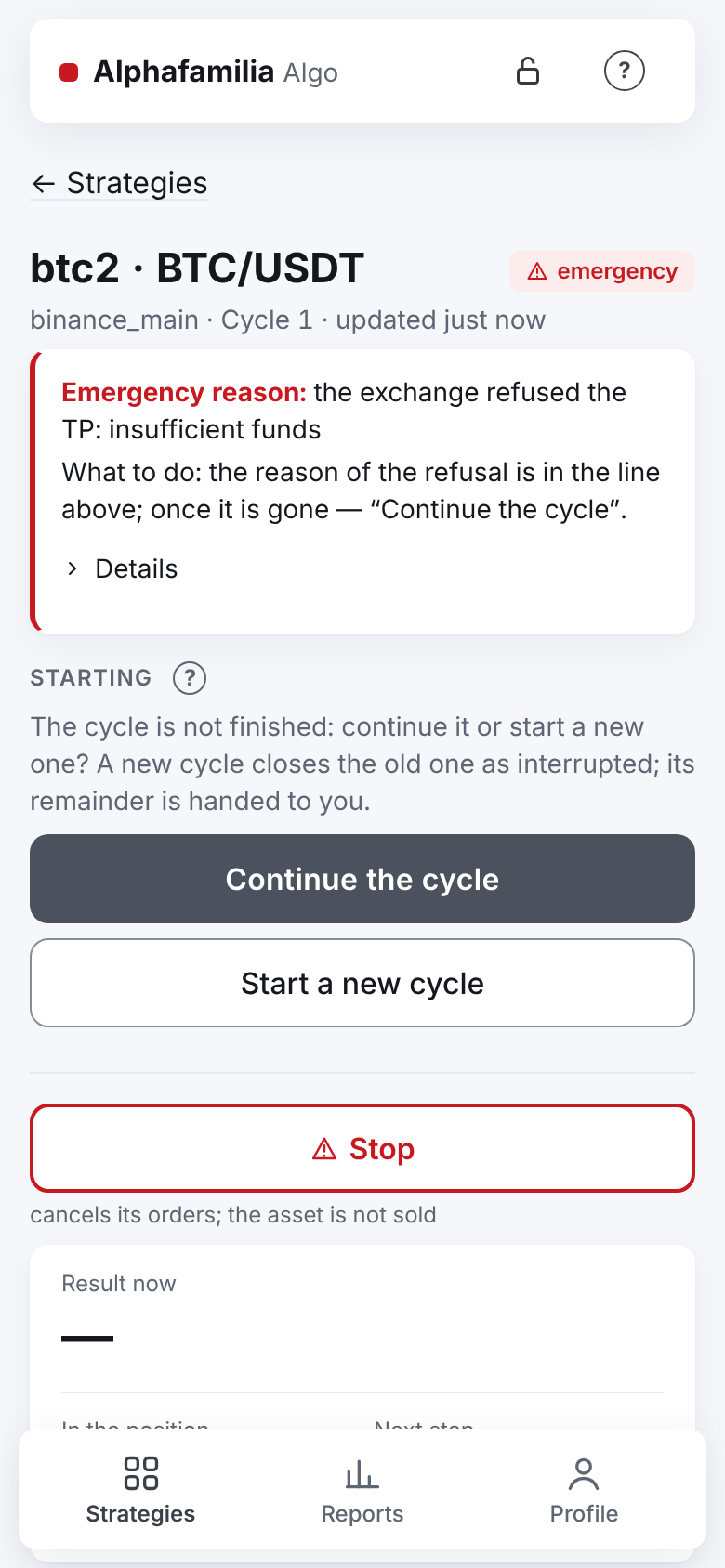
What to click
The buttons are in the "Starting" block at the top of the screen; what each does is said in the window of its "?".
- "Continue the cycle" — the strategy checks with the exchange again and finishes the cycle. Suits you if the cause has been removed. If the trade still cannot be counted, the strategy goes into an emergency again.
- "Start a new cycle" — the old cycle is closed as "interrupted"; its remainder is yours. The strategy starts a new cycle from the current price. The action's button in the confirmation window is red.
- Click nothing — the strategy stays in the emergency, with no orders on the exchange. You can close the position yourself on the exchange.
- "Stop" — move the strategy from the emergency to stopped. If the cycle is not finished, the button stands apart in the "Starting" block — under "Continue the cycle" and "Start a new cycle", behind a line. After the stop the strategy's screen keeps one grey line with the emergency's reason — until the next start.
- "Archive" — if you no longer need the strategy.
Important. If the reason is "an order of the strategy on the exchange it has no record of", first cancel that order on the exchange by hand. Otherwise the strategy stops again. The strategy leaves such an order on the exchange on purpose, so that you can look into it.
If the account has less asset
There is one rule. For every asset of the account — a coin on spot (for "sell first" strategies: the pair's currency, apart from the coin), a side of a contract on futures (long and short apart) — the system adds up the records of all the strategies of that asset (working, stopped, in an emergency) and compares the sum with what the account holds in all: free plus what lies in orders (a TP keeps its coins on the account — that is no shortage). Coins held by an order of a strategy of another asset are that strategy's: a DCA sale of a "sell first" strategy holds the coin, a buy of a "buy first" strategy holds the money. They are not counted for the strategies of this asset. Example: the account holds 0.0025 BTC — 0.0010 of a "buy first" strategy and 0.0015 in a "sell first" strategy's DCA sale; 0.0010 sold by hand — nothing is left for the first strategy, a discrepancy, though the account holds 0.0015 BTC.
- The account holds no less than the sum — it agrees. More is no discrepancy either: your own coins, a manual position beside the strategies.
- Less, and all that is missing is covered by the dust on the records of the asset's strategies (spot, "buy first": the last cycle's remainder smaller than the smallest order — or this cycle's remainder smaller than the smallest order that a sale left (a partial TP) and a purchase later filled on top of — then what lies beyond the last whole quantity step — that happens when the fee is taken in the coin) — that dust is written off in a fixed order: first the dust carried from the last cycle of every strategy, then what lies beyond a step; from each strategy no more than its own. Dust is taken only from a strategy that places its orders anew after the write-off: a working one — or one with no orders on the exchange, a stopped strategy or one in an emergency included: on "Continue" such a strategy places its TP on the reduced records, and it is not refused. The dust of a paused strategy with orders on the exchange is not taken: its TP would keep selling the quantity written off, and a neighbour would get its TP refused through no fault of its own. Nor is it taken from a strategy whose records were read from the database (disabled by a program error, or its stop not saved yet): such records are never changed. Without that dust the shortage is a discrepancy (see below). The "Events" of the strategy whose dust is written off say: "the coin's small remainder is not on the account — the strategy no longer counts it". The TP goes on the coins that are left; no emergency.
- Any other shortage is a discrepancy, even one step: the pair's smallest order is only the limit of what counts as dust, not a tolerance. Every working strategy of the asset that holds a share by its records goes into an emergency: its orders are cancelled, the coins and positions stay, nothing is sold (a paused strategy with a share too). A strategy without a share (new, with no open cycle, or between cycles with only the last cycle's dust) does not go into an emergency: it starts nothing, shows "the account does not agree in BTC: the strategies on BTC need 0.03 BTC, there is 0.01 BTC; the strategies of this asset: …" and keeps no orders on the exchange; it starts by itself once the account agrees.
- A discrepancy with nobody in an emergency (a stopped strategy's coins sold, and the working strategies of the asset hold no share of their own) does not go unnoticed: one message "🔴 The account does not agree" comes with the same figures and the strategies of the asset — see Telegram messages. The same figures are not sent twice; changed ones are sent again.
The reason says what is missing: "less asset on the account than counted: the strategies on BTC need 0.03 BTC, there is 0.01 BTC" (the code asset_short:BTC:need=0.03:have=0.01), on futures "the BTCUSDT long needs 0.001, has 0" (asset_short:LONG:BTCUSDT:…). "Needs" is the sum of the records of all the asset's strategies. The message comes for every strategy in the emergency and names all the strategies of the asset: "Strategies of this asset: …"; a futures strategy's holding in it reads "0.012 in the ETHUSDT long". The exchange shows one balance per account and does not say whose coins left it — so the system does not guess whose part is gone.
The blind spot of a mixed account: the coins of a "sell first" strategy it has not sold yet (its unsold budget) are a plan, not a record, and they are not part of "needs". So a sale of a buying strategy's coins by hand goes unnoticed while their place on the account is covered by the selling strategy's free budget; the selling strategy later gets "insufficient funds" for its sale. The budget cannot be counted as a record: with the coins not brought to the account in full, the buying strategies would get a false emergency.
The account's balance and the strategies' records are not read at the same moment: a neighbour's TP may have filled between them. So a first shortage that the fill of resting orders could explain is a doubt, not an emergency: the system waits until every strategy of the asset has read its trades, none has an order whose outcome is not known, and the exchange shows no execution beyond the records (BingX, Bybit and Coinbase show a trade late). Still short then — a discrepancy. It waits no longer than 2 minutes (on BingX, Bybit and Coinbase plus their delay, up to 12 minutes); a calm moment that does not come is a discrepancy too: an unknown outcome. The check is made after the start and "Start", after a restart of the service, when the strategy's own order is gone from the exchange (in "Events": "order missing — the strategy checks the account and restores it"), at once when the TP is refused for "insufficient funds", on futures once a minute; on spot, while a strategy's entry is filled in part and no TP stands yet, once a minute (nothing holds such an entry's coins, and selling or converting them by hand takes no order off); for a strategy waiting with "the account does not agree" — every 15 seconds for the first 2 minutes, then once a minute; for a strategy whose check waits for an order with an unknown outcome — every 15 seconds (not every step: the exchange's request budget). After a restart the check waits until every strategy of the account is loaded ("the check waits for the account's strategies … to be loaded"); after 10 minutes of that the strategy takes its orders off and waits on.
What to do:
- Compare the balance on the exchange (on futures — the side's position) with the "Position" of every strategy of this asset.
- Decide whose cycle is lost: that strategy — "Start a new cycle" or the archive (its remainder is yours, manual); the others — "Continue the cycle": the check passes by the records of the strategies that remain. Example: two long strategies on one pair, one's TP cancelled by hand and its part of the position sold — both in an emergency; the first gets "Start a new cycle", the second "Continue the cycle".
- Enough for all of them (the asset brought back) — "Continue the cycle" for each.
- "The account does not agree" came and nobody is in an emergency: a stopped strategy's coins sold — "Start a new cycle" or the archive for it; the asset brought back to the account — the waiting strategies start by themselves.
- If the exchange liquidated the position or closed part of it by ADL, the reason says so plainly — see USD-M futures.
Technical faults: the strategy copes by itself
| Situation | What the strategy does |
|---|---|
| No answer from the exchange to a new order | Changes nothing about this order and finds out what happened to it by its number. Never sends it again blindly |
| The exchange does not answer (errors, timeouts, an error page or an empty answer instead of an answer) | Skips the step, does not touch the orders on the exchange, keeps the pair's rules as they were, tries again after 1, 2, 4… up to 20 seconds. Such an answer is never taken as "no coins or money", "no position", "the pair is gone" (an empty list of pairs included), "the order is placed" or "the order is cancelled": the strategy finds out an order's outcome by its number, and an order is cancelled only when the exchange confirmed it |
| The price has not been updated for more than a minute | Places nothing new ("price is stale"), leaves what is already placed |
| The fee rate is unknown | Waits ("fee rate unknown") |
| The exchange's fee is 10 % or more | Waits without changing anything ("the exchange's fee is 10 % or more — the strategy waits") |
| The database does not answer | Sends no new orders; the placed ones stay. When the database answers, goes on as after a restart. "Stop" (a single strategy's and the group one under the list) works meanwhile: the strategy trades no more, takes its own orders off at once, and the stop is recorded as soon as the database answers — even if you have locked the vault by then. The app says so: "The stop is accepted but not recorded yet…" — and names the orders the exchange did not confirm off: they may still stand on the exchange, check them there. Until then the group "Start" under the list of strategies (and the server command "start all") passes this strategy by ("stopped by you, the stop is not recorded yet"); only its own "Start" starts it. If the server restarted before the database answered, the stop is not recorded: the strategy does not trade by itself, but after opening the vault press "Stop" for it again |
| Many requests to Binance | The requests of all the server's strategies go through a shared budget below the exchange's limit. Binance's spot, USD-M futures and COIN-M are three separate limits, so the budget is split separately by market: equally between the users whose Binance strategies are running on that market now (a strategy that has not finished loading counts on each). One user's strategies do not take another user's part. TPs, cancels and checks of own orders go first; new entries and DCA wait. If some other program also loads the server's address and the exchange counts more than our budget, reads, entries and DCA wait, while TPs and cancels go on — with the reads a TP after a fill cannot be placed without — but never above 95 % of the exchange's own limit |
| The Binance event stream is not working (dropped, silent, the exchange's fault) | While the stream works, the strategy takes fills straight from it (the TP in about a second) and checks them against the exchange: the orders every 5 minutes, the trade history every 5 minutes on futures and every 10 minutes on spot. The stream dropped — the strategy checks against the exchange at once and, until the stream works again, learns of fills by asking the exchange (every step, 3 s): a TP may come a few seconds later. The stream fell silent without dropping: the fill is seen at the check of the orders — within 5 minutes (on futures also by the position, within 5 minutes too), after that the strategy asks the exchange every step. No fill is lost or counted twice. The stream connects again by itself. If it does not work for 10 minutes — one message "🟠 The Binance event stream is not working", when it works again — one "✅ The Binance event stream works again". Nothing to do |
| Binance temporarily banned the server's address | All the server's Binance strategies of the API that is banned (spot, USD-M or COIN-M; on the test network USD-M and COIN-M wait together — they share one address) wait for the time the exchange gave and a few seconds more; after it the requests resume gradually, over 10 minutes. Orders on the exchange stay and may fill. "🔴 Binance banned the server's address" comes: tell the developer, the strategies go on by themselves |
| Binance halted trading of the pair (at Coinbase — also when the pair takes limit orders only: Coinbase) | Waits and tries again. After 15 minutes — a message, then "Trading of the pair is back". The strategy sees the halt at once if the exchange refused an order, otherwise within 5 minutes; that trading is back — within 5 minutes too |
| The entry is only partly filled, no TP is set | The limit entry bought (sold) only a part. The strategy waits for the entry to fill whole and only then places the TP; the entry is moved to the market. The message comes after 15 minutes of waiting, once per cycle. You can decide by hand: place the TP yourself or cancel the entry |
| T-Invest: no trading (night, weekend) | Waits quietly, without messages |
| Futures: the exchange does not give the funding payments | Trades as usual, reads funding in the next steps. After 30 minutes with a position open — "🟠 Funding is not read", then one "✅ Funding is read again"; the payments are booked in their cycles, closed ones included |
If the strategy cannot make a working step for 5 minutes, "🟠 Technical fault" comes with the reason and the last line "Nothing to do — the strategy waits and goes on by itself.". A reminder — every 30 minutes. When everything is fine again — one "✅ Recovered". A fault shorter than 5 minutes is not reported.
One exception — the exchange does not take the connection's key (the key was deleted on the exchange, has expired, its rights or its list of addresses were changed). Then the message comes with the 🔴 sign and the reason "the exchange does not take the connection's key — it is gone, has expired or was changed", and the last line tells what to do: check the key on the exchange and replace it in the app (Profile → Settings → Exchange connections → Replace key). A strategy that has to place an order at that time goes into an emergency with the exchange's answer; the others wait. The strategies of other connections work as usual.
During a fault the strategy's screen shows "last step: no connection to the exchange" and the reasons for waiting in the "Waiting" line. In "Events" each such step is a line in the words of the message: "no connection to the exchange (ConnectionRefusedError)", "the exchange does not answer in time (TimeoutError)", "the exchange answers with an error on its side" or "requests to the exchange are paused for 8 s (protection against the exchange's limit)" — a pause before the exchange's limit of requests, it passes by itself.
No money and exchange refusals
| Situation | What the strategy does |
|---|---|
| Not enough funds for the entry or an averaging order | "🟠 Not enough funds" with an "Open the strategy" button and the line "What to do: top up the account by … or lower the strategy's budget in Change settings (from the next cycle)."; retries after 5, 15, 30, 60 minutes, then once an hour. The TP stays. When it works — one "✅ Funds are enough" |
| The exchange refused the entry or a DCA for another reason | "🟠 The exchange refused an order" with the reason in words, the same retries. "Nothing to do — the strategy tries again by itself." When it works — one "✅ Order placed" ("… placed after the exchange's refusal") |
| T-Invest: an order outside the price band | An ordinary refusal, the same retries |
| Your manual limit order refused by the exchange's rules (price outside the band, amount below the minimum, step; on T-Invest — the broker's refusal by price or quantity) | The order is taken off at once and not repeated: "🔴 The exchange refused the manual order" with the reason and the exchange's reply. Correct the price or the amount and buy again. No funds, no answer from the exchange, request limit, market closed — retried on schedule, as for DCA |
| Your "Market" purchase failed (no funds, the exchange refused, limit-only trading, not sent within 2 minutes) | No retries, the command is over: "🔴 Manual N: the market buy was not made". Buy again once the cause is removed. An unknown answer of the exchange the strategy finds out and does not send again (T-Invest takes a repeat of the same order without a second purchase — the strategy repeats it only for 2 minutes) |
Every refusal message and the strategy's Events carry the exchange's reply as it came: " · Exchange reply: 101211 The order price is out of range". The time of the next try is shown on the strategy's screen: "Retry DCA2 at …", and in the list of strategies — the badge "Not enough funds" or "Exchange refused" (Needs attention). The "Start" button (of a stopped strategy) resets the wait and tries at once.
With several strategies on one account, "free" in the message is what is free on the whole account, and the strategy takes from it only what is nobody else's: coins and money the other strategies of the account have counted are never spent. What a neighbour already keeps in its own resting order (its TP) the exchange does not show as free anyway — it is not taken off a second time. A neighbour's buys resting below the market (its DCA) keep nothing: they have not bought yet. Only a neighbour's buy that may have filled before it counted it (at market, the price reached it, its outcome unknown) is kept aside.
Warnings about orders
| Message | What it means |
|---|---|
| "Order stuck" | The price passed the order's level 10 minutes ago, but there is no fill. Check the order on the exchange — the strategy waits for its fill |
| "Cancel not confirmed" | No confirmation of the cancel for 5 minutes; after 15 minutes — an emergency |
| "Trades are late" | The exchange shows the order as filled, but there have been no trades for 5 minutes. The strategy does not treat it as filled and does not place the next one |
| "Strategy's order removed by someone else" | A strategy's order was cancelled or changed in the exchange's app. What was filled is counted; the strategy places the order again. Before putting back a TP that was taken off, the strategy checks the account by the rule of "If the account has less asset": short — the emergency "less asset on the account than counted". Coins and money in the orders of strategies of another asset (for example, the coins in the sales of a "sell first" strategy) are theirs: they are added to "needs", and "there is" in the reason is the whole balance of the account |
| "Orders left on the exchange" | The strategy could not cancel its orders. Cancel these orders on the exchange by hand (the message's "Open the strategy" button leads to the strategy) |
The full list — Telegram messages. Detailed rules — The strategy's rules in detail.
BNB fee on a BNB pair
When fees are paid in BNB, Binance takes the fee of a BNB sale in BNB on top of what is sold. If a BNB/USDT strategy's remainder is smaller than this fee, the exchange takes the missing part from the account's BNB reserve. The strategy does not go into an emergency: the TP sells the whole position, and this part of the fee is a cost of the cycle at the trade's price; for a strategy with the profit kept in BNB it lowers the cycle's profit in BNB (the cycle may show a small minus in BNB). To keep a reserve, watch for the message "little BNB left for fees" — it comes when the BNB beyond what the strategies count as theirs is below 0.02 BNB or 12 USDT (Keys on the exchange side, Messages).
The last cycle's remainder is gone
If between cycles you converted the last cycle's dust (for example, into BNB), the strategy does not go into an emergency. There is no separate rule for it: the converted dust is written off by the same account check ("If the account has less asset") at the next occasion — the start, "Start", a restart of the service — in a calm moment, once the neighbours have read their trades (before 2.1.76 the strategy wrote the carried dust off between cycles by itself, by a guess — and could write it off when nobody had converted anything and the account's balance simply did not yet count a neighbour's TP). The strategy's "Events" say: "the coin's small remainder is not on the account — the strategy no longer counts it". A remainder that can be sold is not let go like that: if it is not on the account, it is the emergency "less asset on the account than counted".
Dust converted while the cycle is open is written off at the next check by the rule above (the dust carried from the last cycle, then what lies beyond a step). If no check came before and the exchange refused the TP sized with the converted dust ("insufficient funds"), the strategy checks the account first, once: the dust is written off, the TP goes on the coins that are there — no emergency. The same when a neighbour's dust was converted and its TP took other coins in its place: the neighbour's dust is written off, and the strategy's TP is tried again once the neighbour has replaced its TP (every 15 seconds, for no more than 2 minutes — an emergency at once would give false emergencies in the window of seconds while the neighbour's TP sells the dust written off). The dust of a paused neighbour with orders on the exchange is not written off like that — its TP would be selling it; a shortage without it is a discrepancy. Refused again with the same dust on the records, or more missing than the dust — an emergency, as for any refusal of the TP. A remainder smaller than the smallest order that a partial TP left stays dust after an averaging of the same cycle filled on top of it: converted before that, it is written off without an emergency and the TP is placed on what the account holds (owner's decision 21.11). The coins of a limit entry filled by less than the smallest order are dust too while the entry rests; converted and then filled whole, they are no longer dust: a discrepancy and an emergency (the parts of one order are no remainder of a sale).
Next: USD-M futures