I want to trade COIN-M futures (in BTC)
At the end of this path a strategy on Binance COIN-M futures holds a long on the BTCUSD_PERP contract, and the pledge, the fees, the funding and the profit are counted in BTC, not in USDT. You will know how the grid is turned into whole contracts, why the profit is in BTC and why a long on COIN-M is riskier than a long on USD-M.
Go through I want to trade futures first: leverage, liquidation, funding and Hedge Mode are the same here. This path is only about how COIN-M differs.
How COIN-M differs from USD-M
- The money is BTC. The pledge (the margin), the fees, the funding and the profit are in BTC on the COIN-M wallet. USDT takes no part here.
- A contract = 100 USD. Orders are whole BTCUSD_PERP contracts only. Quantities on the screens are in contracts: “45 contracts”.
- The position size is in BTC (up to 8 decimal places). Margin = position size ÷ leverage, in BTC too.
- A long's double risk. The pledge is BTC itself: when the price falls, both the position and the pledge lose. The liquidation is closer than on USD-M at the same leverage (below).
- Long only for now, BTCUSD_PERP only and perpetual only (what is not there yet).
What you need
- The quiz of lesson 14 of the Trading school passed — “Leverage, margin and liquidation” (without it no futures connection, COIN-M included, can be added).
- Experience with a USD-M futures strategy (the path I want to trade futures).
- A Binance futures account with its COIN-M section.
- A Binance key that may trade futures (“Enable Futures”), without withdrawals, with the server's address in the IP list. Binance has one right for USD-M and COIN-M — the key of the USD-M connection will do.
- BTC on the COIN-M wallet. You move it from spot or USD-M yourself at Binance. The “First steps” checklist counts a COIN-M connection's money in BTC (the threshold is 0.003 BTC, ≈ 300 USD at the price 100,000).
- First — a test environment: the Binance test network (demo trading, https://demo.binance.com; keys of the old site testnet.binancefuture.com work too). It is the same key as for the USD-M futures test network; the demo account's COIN-M section is its own. The test BTC is on the COIN-M wallet already, there are no IP restrictions.
- The BTCUSD_PERP pair in the administrator's lists. On the “Binance COIN-M futures” market it is allowed by default: “Assets” — BTC, “Profit currencies” — USD.
Steps
At Binance open the COIN-M futures and switch Hedge Mode on there — COIN-M's position mode is its own, apart from USD-M: switched on for USD-M it does not apply here. The margin — Cross. The strategy checks the COIN-M account's mode itself; if it is another one, the strategy waits and says what to switch on (Preparation).
Move BTC to the COIN-M wallet (not needed on the test network).
In the app: “Profile → Settings → Exchange connections” → “+ New connection”.
Choose the market “Binance COIN-M futures” and the environment: for a try — “test network”, for trading — “main”. Under the market — a hint about COIN-M. Press “Next: the key →”.
Above the key fields — “Before you create the key on Binance”: for the live environment the first point is “Turn futures on: "Enable Futures" (one right for USD-M and COIN-M). Before the start move BTC to the COIN-M wallet and switch Hedge Mode on in the COIN-M section.”, then withdrawals off and the server's address for the IP list (the test network has its own short list). Paste the key and the secret. Even if the key is the one of the USD-M connection, type it here again: the COIN-M connection is a separate one. Press “Check the key”: the app asks the COIN-M account itself. The “Check result” shows “Futures allowed” with ✓.
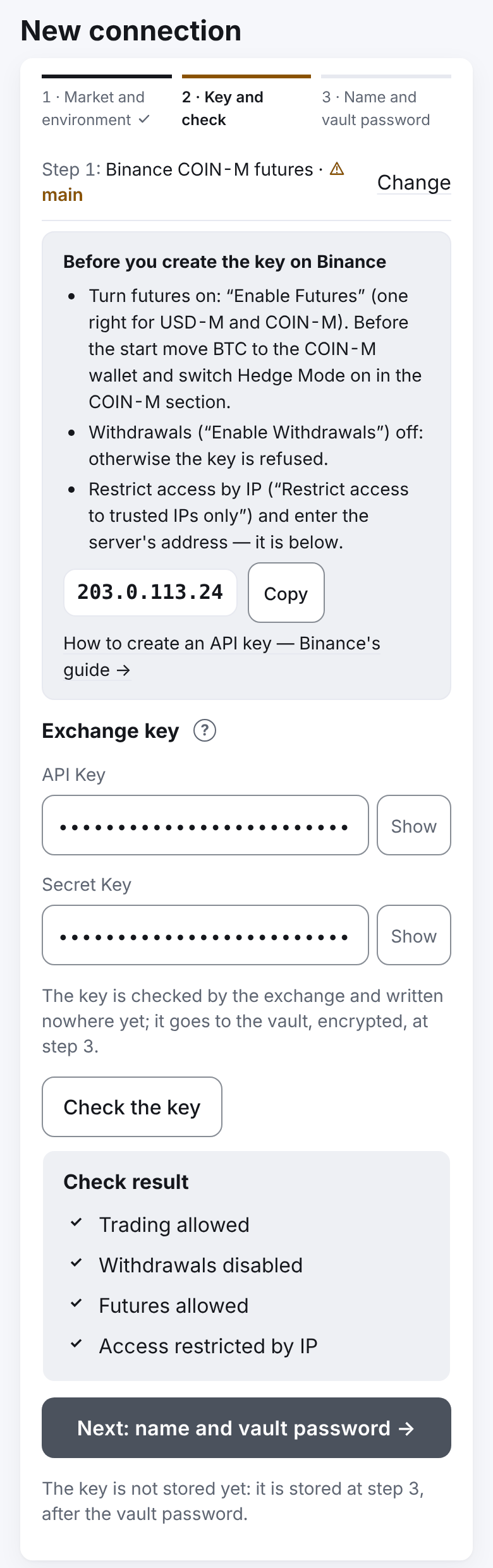
“Next: name and vault password →”, the vault password, “Add” (for the live environment — “Add the live key” and a confirmation).
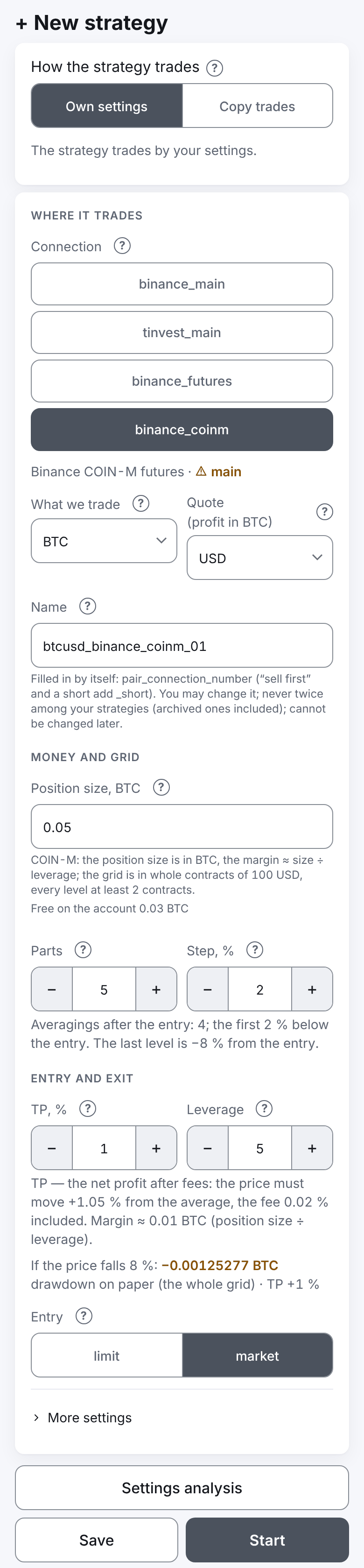
Press “+ New strategy”, choose the COIN-M connection and the pair BTC/USD (that is BTCUSD_PERP). The pair's second field on COIN-M is called “Quote (profit in BTC)”: the price is in USD, the profit in BTC.
Type the “Position size” (the field “Position size, BTC”) — in BTC, for example 0.05. Under the field: “COIN-M: the position size is in BTC, the margin ≈ size ÷ leverage; the grid is in whole contracts of 100 USD, every level at least 2 contracts.”
Set the “Leverage” (1 to 10; to begin — 1 or 2). Next to the TP you see “Margin ≈ … BTC (position size ÷ leverage)” — that much BTC the COIN-M wallet needs.
The side is long only: in “More settings” → “Mode” the “short” button is off, under it — “COIN-M: long only for now — the short comes as the second step.”
Press “Settings analysis” and look at the grid: each level has its contracts, its value in BTC and its nominal in USD. If the size is too small, under the form's fields (and in the window, under the grid) — “The smallest position size for this grid is … BTC: every level at least 2 contracts (20 % above the exchange's minimum).” Such a strategy is not saved — raise the size or lower the number of parts. The TP in the grid is an estimate at one fee rate; the exact TP is counted by the strategy in the cycle from the actual trades. In the steps' table of “Settings analysis” the profit is the TP % of the grid's value in whole contracts, not of the whole size: in the example below from +0.00003 BTC at the entry to +0.0004768 BTC at the last step.
Press “Start” (it saves and starts at once) and confirm in the window “Save and start…”.
How the grid is counted: an example
The example is confirmed by the system administrator; the program is checked against it. Position size 0.05 BTC, leverage 5 (margin 0.01 BTC), market entry at 100,000 USD, 5 parts, step 2 %, parts growth 50 %, TP 1 %. Binance COIN-M fees: a market entry — 0.05 %, limit orders — 0.02 %.
| Level | Price, USD | Share of the size, BTC | Contracts | Nominal, USD | Value, BTC |
|---|---|---|---|---|---|
| Entry | 100,000 | 0.00379147 | 3 | 300 | 0.00300000 |
| DCA1 | 98,000 | 0.00568720 | 5 | 500 | 0.00510204 |
| DCA2 | 96,000 | 0.00853081 | 8 | 800 | 0.00833333 |
| DCA3 | 94,000 | 0.01279621 | 12 | 1,200 | 0.01276596 |
| DCA4 | 92,000 | 0.01919431 | 17 | 1,700 | 0.01847826 |
| Total | 0.05000000 | 45 | 4,500 | 0.04767959 |
- Contracts — down to a whole one at each level: the share in BTC × price ÷ 100 USD. The rest is not carried to the next level, so not all the size is used: 0.04767959 of 0.05 BTC. The smaller the size, the coarser the grid.
- The average price is by BTC, not by contracts: the whole nominal ÷ the whole value in BTC = 4,500 ÷ 0.04767959 = 94,380.00 USD. The average “by contracts” would be 94,444.44 — for COIN-M it is wrong.
- The TP is the price at which the net profit in BTC after the entry's and the exit's fees is at least 1 % of the position's value at entry: 95,373.5 USD (+1.05 % from the average).
- The cycle's profit — 0.00047679 BTC (≈ 45.47 USD at the close price). The TP's target is 0.00047680 BTC (1 % of 0.04767959); the exchange rounds the fees to 8 places, and the books come out lower by a fraction of the last digit.
- If only the entry filled (3 contracts): TP — 101,081.4 USD, profit — 0.00003000 BTC.
- Why the TP is above +1 %. On COIN-M a 1 % rise of the price gives a long only about 0.99 % in BTC: the position in BTC gets cheaper as the price rises. So 1 % in BTC needs a rise a little above 1 % plus the fees.
- The smallest size. Every level — at least 2 contracts (20 % above the exchange's minimum of 1 contract). For this grid at the price of 100,000 the minimum is 0.0264 BTC. With 0.02 BTC the levels would be 1, 2, 3, 4, 7 contracts — the entry is below 2, the strategy is not created: “at least 0.0264 BTC is needed”.
How to know it worked
In the list the strategy is “running”, the risk strip: “Long 5× · notional 0.04767959 BTC of 0.05 BTC · … % to liquidation” — the notional in BTC. On the strategy's screen the same strip also has the liquidation price in brackets.
On the strategy's screen the quantities are in contracts (“45 contracts”), the money in BTC up to 8 places (on the screen — without trailing zeros, in Telegram — always 8), the nominal in USD for reference. The average price is by BTC.
In the “Cycle” card: “Position: 45 contracts · 0.04767959 BTC” — the position's value at entry before fees (contracts × 100 ÷ the price of each trade, as in the example), “Notional: 4,500.00 USD”, “Entry fees: 0.00001044 BTC” — apart.
In the “Futures” card: “Notional” and “Funding this cycle” are in BTC; “Liquidation price” is two prices: “Exchange: X · strategy's estimate: Y” (why two). Right after an averaging the exchange's price is still the old one (up to 5 minutes): “Exchange: — · strategy's estimate: Y · updated at the check” — the strategy's estimate is already the new position's.

In Telegram the fill messages are in contracts and BTC: “17 contracts”, “0.01847826 BTC (1,700.00 USD)”, the average by BTC; “💰 Cycle N closed” has the profit in BTC and the line “In USD at the close price”.
In the reports “Profit, BTC” is a line of its own marked “BTC of COIN-M futures — apart, not in the total · In USD at the close price ≈ … USD”. It is not added to USDT. The morning summary keeps it apart too: “+0.00047679 BTC (≈ 45.47 USD)”.
Manual control on COIN-M
The buttons are those of the other strategies (I want to manage my strategies). The differences:
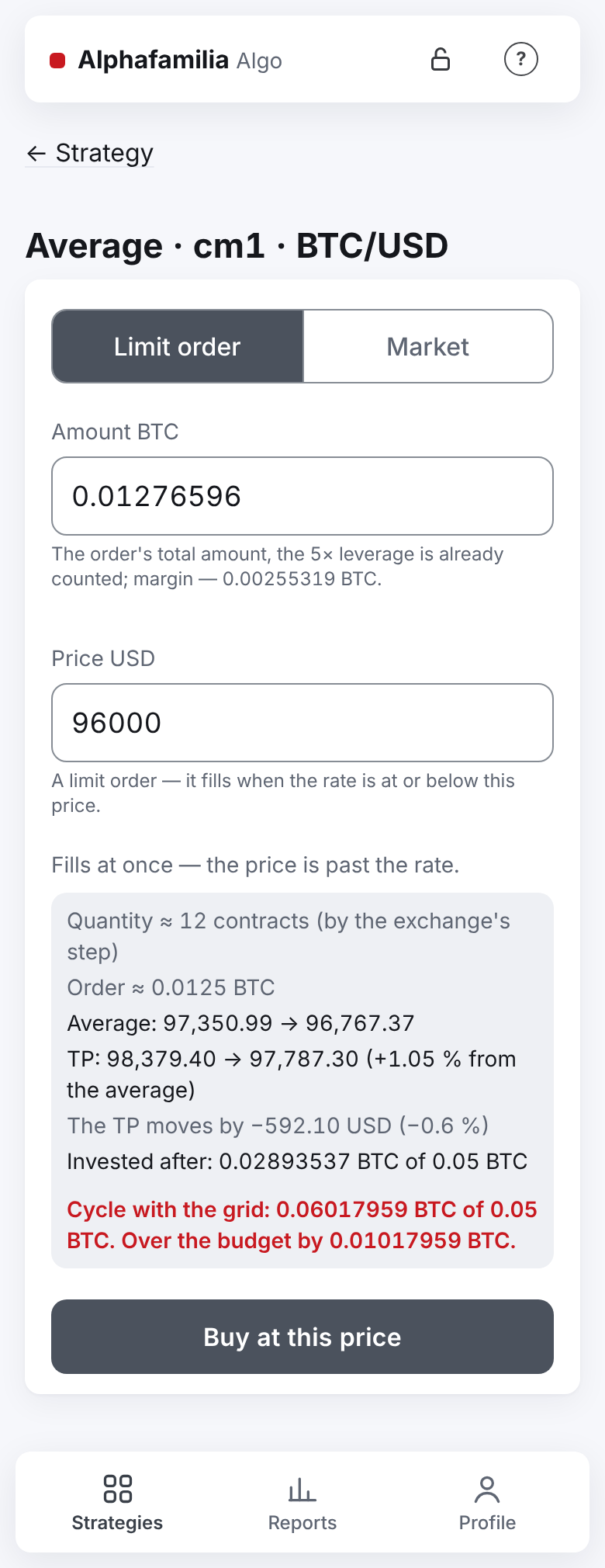
“Average” — the “Amount” is in BTC. By default — the next level's amount: it gives exactly its contracts. The amount is turned into whole contracts, down; under the field you see the margin, below — “Quantity ≈ 12 contracts (by the exchange's step)”, “Order ≈ … BTC”, the new average and the new TP. A market buy checks the BTC of the COIN-M wallet too.
“TP” — in percent from the average (the average by BTC) or by price. A “+Y %” TP is rounded up to the price step: the profit is at least Y %, as with the TP of the settings. “+1 %” here is the same TP as the settings' TP of 1 % (95,373.5 in the example).
“Levels” — the levels and the manual orders in contracts; “Invested and planned” — in BTC.
The money check. Before every opening order (the entry, a DCA, a manual buy) the strategy itself checks the free BTC on the COIN-M wallet: margin + fee is needed. Not enough — “Not enough funds” with the sum “need … BTC” and a retry on schedule, as on spot. The TP and the closing orders are not checked.
What you risk
- A long's double risk. The pledge is BTC. An example: 50 contracts (5,000 USD) at 100,000, a pledge of 0.01 BTC (= 1,000 USD). The price fell by 10 % — to 90,000: the loss is 0.00555556 BTC, 0.00444444 BTC = 400 USD is left. On USD-M with the same figures 500 USD would be left. The liquidation of such a position is about 83,333 USD (−16.7 %), and on USD-M with leverage 5 — 80,000 (−20 %). At the same leverage a long on COIN-M is liquidated earlier.
- Two liquidation prices. “Exchange” — Binance's estimate for cross margin: the whole BTC of the COIN-M wallet is the pledge. “Strategy's estimate” — where the strategy's own margin (the position's value at entry ÷ leverage) is gone. The risk strip, the distance to the liquidation and “🔴 Close to liquidation” go by the more cautious one — for a long the higher of the two. While the exchange's price is “updated at the check” (up to 5 minutes after an averaging) — by the strategy's estimate, without waiting for the exchange.
- Cross margin. The whole BTC of the COIN-M wallet is the pledge, and all of it loses value with the price. Keep on the COIN-M wallet only what you are ready to risk.
- The profit is in BTC. If BTC got cheaper, the same profit in BTC is worth fewer dollars. USD in the reports is for reference only, at the cycle's close price.
- A coarse grid. Whole contracts of 100 USD: with a small size part of it is not used (in the example — 4.6 % of the size, at the entry — 21 %).
- The TP may not be placed. A long's profit in BTC on an inverse contract has a ceiling. If the cycle's fees and funding in BTC ate more than any price can give at the set TP %, there is no TP price: “🔴 No TP placed: the fees and the funding ate the profit”. The DCA levels stay.
- The rest is as on any futures: there is no stop-loss, “Stop” does not close the position (I want to trade futures).
If something goes wrong
- “The position size is below the smallest for this grid: at least … BTC is needed”. Raise the position size to the one named or lower the number of parts and the parts growth.
- “🔴 No TP placed: the fees and the funding ate the profit”. Lower the TP % in the strategy's settings or set your own TP with the “TP” button (by price — at a loss too, if you agree). Otherwise the strategy waits without a TP. One message per cycle and position.
- “Not enough funds” (need … BTC). Move BTC to the COIN-M wallet. The strategy retries itself.
- “Waiting: the account is not in Hedge Mode / cross margin”. Switch Hedge Mode and Cross on in the COIN-M section — the USD-M setting does not apply here.
- The key is not taken (“Futures not allowed” or a Binance code). Switch “Enable Futures” on for the key; a key made before the futures account was opened cannot do it — create a new one.
- “COIN-M is long only for now: the short comes as the second step”. A short on COIN-M is not created yet.
- “Copies of COIN-M strategies are not made yet — copying on COIN-M comes as the second step”. Copying a COIN-M strategy and copying onto COIN-M are not possible yet.
- “🟠 High load on the server's address at Binance” — “COIN-M futures: …” (to the system administrator only). COIN-M has its own request limit. Nothing to do.
The rest — Something went wrong — how to fix it.
Not available yet
- The short on COIN-M — as the second step.
- Copying trades from COIN-M and onto COIN-M — as the second step.
- Other pairs (ETHUSD_PERP and other …USD_PERP) — as the second step; only BTCUSD_PERP is checked now.
- Quarterly contracts are not supported — perpetual only.
- “Profit in the coin” is not needed: the profit is in BTC already.
- A discount for paying fees in BNB does not exist on Binance COIN-M — the fee is always in BTC.